
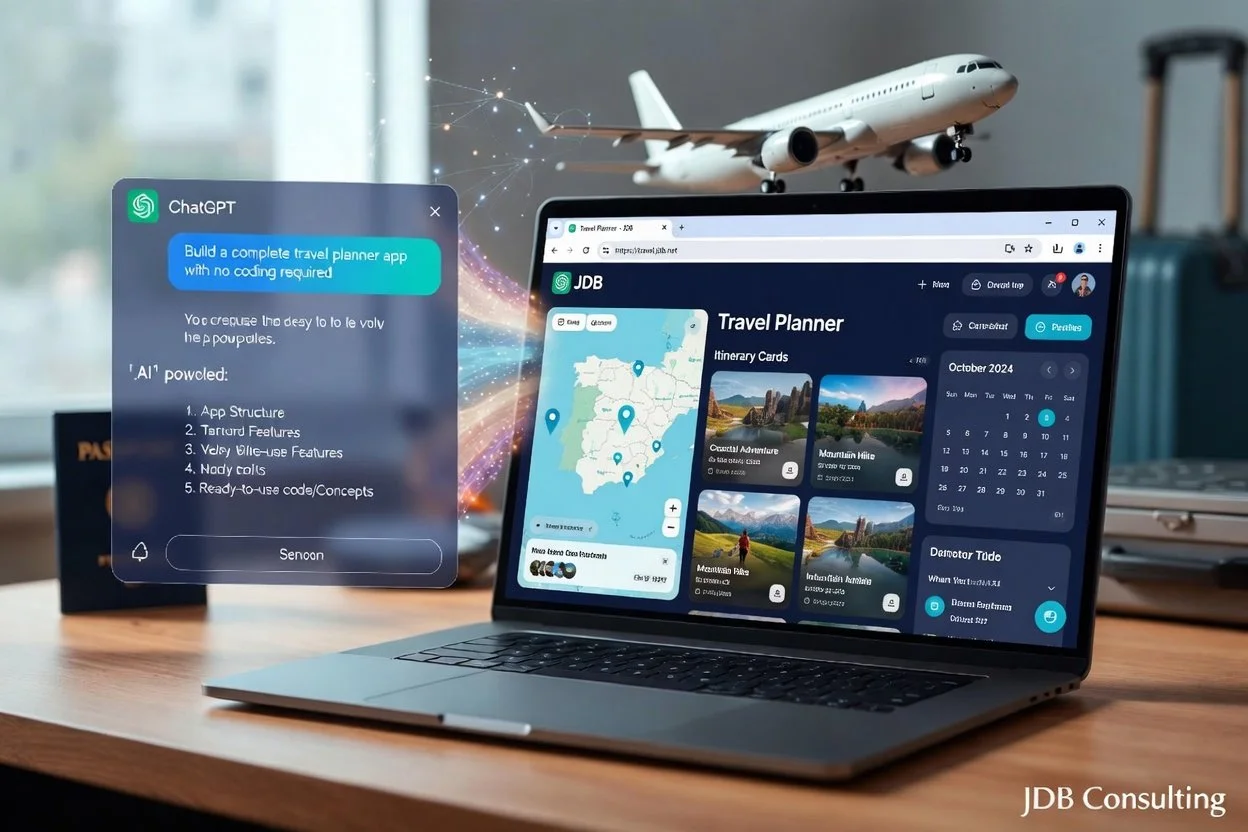
UPDATES: I’ve made more changes to the app since posting this blog on 4/30/2026. See the NOTES at the bottom of the blog.
Over the last few days I put ChatGPT 5.5 and Codex to the test in a serious way. I started vibe coding on Monday and finished today (Thursday April 27th). Roughly 10 hours total time invested — and at least half of that time was spent testing features thoroughly. The 1st hour was spent doing it wrong then I started over. The last hour was figuring out how to setup GitHub to load it there. This wasn’t casual weekend tinkering; it was focused, deliberate work.
The result is a fully functional, mobile-first Travel Log app that I’m actually going to use for my upcoming trip. It’s live right now at travel.jdb.net.
What I Built
A clean, self-contained travel itinerary manager with:
-
Trips grouped by name and automatically sorted by earliest event
-
Events sorted chronologically inside each trip
-
Compact one-line display (date • time • bold location • description)
-
Full add / edit / delete for events and trip names
-
Instant search across every field
-
“Not booked” items automatically highlighted in red
-
Import from pasted text or file (with review step before committing)
-
Export clean text itineraries that can be re-imported
-
One-click PDF export (print-optimized, page breaks between trips, events kept together)
-
Reload the built-in 2027 sample itinerary anytime
-
100% localStorage — no account, no server, works offline (if installed offline).
It currently ships with two incomplete sample trips: an Alaska cruise and a 17-event Spain itinerary.
Security: Everything persists in the browser and feels native on mobile. No data lives on the cloud only on your computer if you want to try it out. That said, I have made only minimal security evaluations of this app and it’s intended for demonstration purposes only. Use it with real data at your own risk. I’m using a local copy of the app for my real trip data.
How I Built It (Vibe Coding in Practice)
I followed the exact workflow I learned in the Generative AI Bootcamp:
-
Wrote a clear PRD (Product Requirements Document) first
-
Used ChatGPT 5.5 and Codex to generate the initial structure
-
Iterated with precise follow-up prompts: “Make the search instant across all fields”, “Add typed-name confirmation before deleting a trip”, “Highlight ‘not booked’ in red”, “Generate a clean PDF export with proper page breaks”
-
Tested every single flow repeatedly — adding events, importing notes, exporting PDFs, checking mobile layout, edge cases, etc.
The 5-hour testing investment paid off. The app feels solid because I caught and fixed dozens of small issues before they ever reached the live site.
Why This Matters
-
If you’ve ever wanted a custom internal tool, client portal, lead tracker, or operational dashboard but didn’t have the budget or timeline for traditional development, this approach is now genuinely viable.
-
You can go from idea to working, usable prototype in a single focused day (or a few evenings). The remaining polish still benefits from human oversight, but the barrier has dropped dramatically.
-
I’m not claiming this replaces professional developers. I am saying the cost and speed of testing new ideas has improved by an order of magnitude. I do have programming experience and I used that to direct the AI, but at no time did I write or look at any code.
What’s Next
I’m already thinking about the next small tool I want to build the same way. The pattern is addictive once you experience it.
If you’re a business owner or operator sitting on an app idea because “we don’t have developers” or “it would take too long,” let’s talk.
I’m now helping companies build AI-generated apps and internal tools using ChatGPT 5.5, Codex, and the same vibe-coding process. We start with a clear requirements document, deliver a working prototype quickly, and iterate until it fits your actual workflow.
Reach out if you want to explore what’s possible for your business. No hard sell — just a practical conversation about whether this makes sense for what you’re trying to solve.
The 10-hour experiment is complete. Turning these capabilities into real business advantage is where the interesting work begins.
Travel Log — because good trips deserve good records, and good records shouldn’t require a complicated app.
Live demo: https://travel.jdb.net
What kind of internal tool or app would you build first if the technical hurdles were this low? THEY ARE! Send me comments here: I read every comment.
NOTES / UPDATES:
– Added features on 6/1/2026:
-
Added a dropdown in the Add Event dialog to pick an existing trip
-
Added a Settings button that floats with the Add Event button
-
Added a choice of search options for the Description field link:
-
ChatGPT
-
Grok
-
Gemini
-
Google Search
-
– Added features on 5/31/2026:
-
Added links to events
-
Added Links and files at the Trip level
-
Debugged some edit dialog issue on iPhone
– Added features on 5/30/2026:
-
Changed Color Scheme to be consistent across pages.
-
Added a link from travel.jdb.net back to this blog post.
-
Added file attachments support.
-
Added a full backup to supplement the TXT backup so all events and files can be copied to a different device. Intended use: sync to a mobile device.
-
Debugged some issues with iPhone browsers.
– Added features on 5/29/2026:
-
Linked the location field to a custom page that displays data from the Internet and links to Google Maps. It works great on mobile too.
-
Getting data to mobile when generated on a computer is a bit tricky as you have to save using the TXT link the get that file uploaded to your mobile device then use the Import feature to load the file.
– Added features on 5/28/2026:
-
Event descriptions link to ChatGPT search URLs in a new tab.
-
PDF export asks whether to include notes each time.
-
Event rows show location, date, time, and description on one line; the date appears only on the first event of each day.
– I updated the App with some fixes to editing and PDF printouts on 5/23/2026
I have added about 5 hours of additional effort to the app. As I used it, I found bugs and added new features